00 | Studying in Japan #0: Getting a Japanese Student Visa from Scratch — From the CoE Application to the Visa
00 | Studying in Japan #0: Getting a Japanese Student Visa from Scratch — From the CoE Application to the Visa
After deciding to study in Japan, the first hurdle is not finding a school or booking flights, but the visa. The Japanese student visa process has many steps, spans half a year, and every step has to happen in the right order: miss one and the next cannot move forward.
This post records my full process, from starting to prepare documents in August 2025 to entering Japan in April 2026. I hope it helps anyone planning to study in Japan.
1. Why Do You Need a Student Visa?
If you plan to attend a language school in Japan for more than three months, you cannot enter on a temporary visitor (tourist) visa; you need the "Student" (留学) status of residence. The process has two main stages:
- Your school applies to the Immigration Services Agency for a Certificate of Eligibility (在留資格認定証明書, CoE) on your behalf
- You take the CoE to a Japanese embassy or consulate in person to apply for a student visa
Note that many schools check your Japanese level before accepting your application (a written test or JLPT result plus a Zoom interview), because Japanese immigration rules require student visa applicants to have at least N5-level basic Japanese.
2. Overall Timeline
The process takes much longer than most people expect. Here are my actual milestones for reference:
| Time | Milestone |
|---|---|
| August 2025 | Contacted the school, completed the Zoom Japanese interview |
| August–September 2025 | Prepared documents, sent scans for pre-check, then posted them to Tokyo by DHL |
| September 2025 | Paid the application fee through Flywire; the school formally submitted the CoE application |
| Late February 2026 | The school collected the CoE from the immigration bureau, confirming approval |
| February–March 2026 | Paid tuition in full, received the CoE as a digital file |
| March–April 2026 | Took the CoE to the Seattle consulate for the student visa, then left for Japan |
From submitting the application to getting the CoE took about half a year. If you plan to start in April, post your documents by October of the previous year at the latest.
3. Document Checklist
These are the documents required by the Kudan Institute of Japanese Language & Culture. Other language schools may differ, but the general direction is the same:
- Student visa application form (original, with guarantor details)
- Personal history form (original, signed by hand)
- Health certificate (original)
- Statement of financial support (original)
- Certificate of your highest qualification (copy)
- Proof of funds of at least 1.6 million yen (original)
- Passport copy (photo page and entry/exit pages)
- Employment certificate (original)
- 6 photos (4cm × 3cm)
- JLPT certificate (if you have one)
What About Proof of Funds?
The Japanese immigration authorities require proof of assets of more than 1.6 million yen (about USD 10,000). I submitted a Fidelity brokerage account statement, and the school confirmed that any account you can withdraw from at any time is acceptable. I recommend attaching a short cover letter explaining what kind of account it is, to make the review smoother.
Note for Dual Nationals
If you hold two passports, submit only the one you are using to apply for the visa. I applied with my US passport, so all documents were based on it, and I did not need to submit my Hong Kong passport.
4. The Zoom Japanese Interview: Real Questions
The interview lasted about half an hour, run in Japanese by a Japanese teacher, and the atmosphere was quite relaxed.
The most important tip: you do not need to be fluent, but you need to understand simple questions in Japanese and answer in short sentences. The questions are all everyday-level; if you have had some exposure to Japanese, they are not hard.
Here are the real questions I was asked, grouped by category, for your preparation:
Self-introduction
- Q: お名前は何ですか? (What is your name?)
- Q: おいくつですか? (How old are you?)
- Q: どちらのご出身ですか?今はどこに住んでいますか? (Where are you from? Where do you live now?)
- Q: 好きな食べ物は何ですか? (What is your favourite food?)
- Q: 日本のどこに行ったことがありますか? (Where in Japan have you been?)
- Q: 何回日本に来たことがありますか? (How many times have you been to Japan?)
Why You Want to Learn Japanese
- Q: なぜ日本語を勉強したいですか? (Why do you want to study Japanese?)
- Q: 好きなアニメは何ですか? (What is your favourite anime?)
I answered Spy × Family (スパイファミリー) and Doraemon; the teacher laughed, and the atmosphere relaxed a lot.
Formal Visa Questions (you may answer in English)
- Q: 現在どんな仕事をしていますか? (What work do you do now?)
- Q: 誰が費用を負担しますか? (Who will pay for your studies?)
- Q: 日本での生活費はどう賄いますか? (How will you cover living costs in Japan?)
- Q: 卒業後はどうするつもりですか? (What do you plan to do after graduating?)
5. The CoE Arrives: What Does It Look Like?
After half a year of waiting, I finally received the CoE from the school. Its official name is the 在留資格認定証明書 (Certificate of Eligibility), signed by the Ministry of Justice and the Director-General of the Tokyo Regional Immigration Services Bureau, and it states the applicant's name, nationality, status of residence (Student, 1 year 3 months) and date of issue.
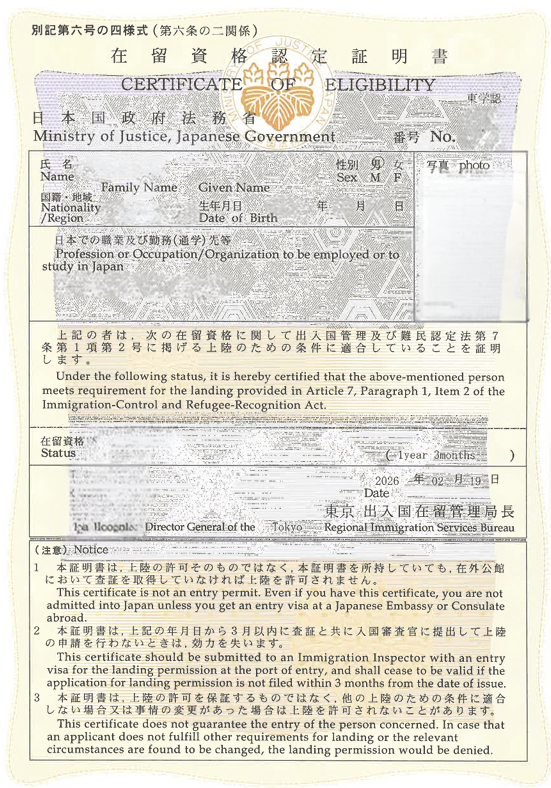 The original CoE: this piece of paper is the core result of the whole study application. Keep it safe, and mind its validity (you must enter Japan within 3 months of issue)
A few important things about the CoE itself:
- The CoE is not permission to enter. With a CoE you still need to get a student visa sticker before you can enter.
- It must be presented to the immigration officer together with the visa within 3 months of issue, or it expires.
- The CoE does not guarantee entry; the immigration officer still has the final say.
6. Applying for the Student Visa at the Seattle Consulate
With the CoE in hand, the next step is to visit a Japanese consulate in person to apply for the student visa sticker. Here is how it worked in Seattle, where I live.
Consulate-General of Japan in Seattle Address: 701 Pike St #1000, Seattle, WA 98101 Phone: +1 206-682-9107 Hours: Monday to Friday 9:00–11:30 and 13:00–16:30
What You Need
- The original CoE (posted by the school) and its PDF
- Visa application form (download from the consulate's website)
- Your original passport
- A prepaid FedEx return envelope
Process
Step 1: Prepare a prepaid FedEx return envelope
The consulate does not do same-day pickup; passports and visa documents are always returned by FedEx. Before you go, prepare a prepaid FedEx envelope with your own name and address, and hand it in with your application.
Step 2: Fill in the visa application form
Download the latest visa application form from the Consulate-General of Japan in Seattle website. A few things to note when filling it in:
- Guarantor field: enter your school's details, i.e. the name and address of the Kudan Institute of Japanese Language & Culture, not a personal guarantor.
- Every field must be filled in, in English or Japanese; none can be left blank.
- The photo must meet the same spec as the application documents (4cm × 3cm, white background).
Step 3: Submit your documents
Bring the following to the consulate in person:
- The completed and signed visa application form
- The original CoE
- Your original passport
- The prepaid FedEx return envelope
In my experience the consulate is quite efficient, sometimes finishing in one or two business days. Check the website beforehand for opening hours and whether you need an appointment; some services may have specific hours.
Step 4: Wait for your passport to come back
After submission, your passport and visa documents are returned by FedEx. Processing usually takes a few business days, but it may take longer in peak season (especially close to the April intake), so leave plenty of time and do not apply too close to your departure date.
7. Common Pitfalls
There are a few places in the process where it is easy to trip up; knowing them in advance saves a lot of trouble:
Send scans for a pre-check before posting documents The school wants to review scans first and only then receive the originals once everything is confirmed. Do not post them straight away; if anything needs fixing, you will lose time.
A brokerage statement works as proof of funds Proof of funds is not limited to bank accounts; statements from brokerages such as Fidelity or Charles Schwab are accepted, as long as the assets can be withdrawn as cash at any time. Attaching a cover letter makes it safer.
Getting the CoE takes about half a year This is the longest wait in the whole process. The immigration review has no fixed timetable and waiting times vary, but half a year is very common, so start your application as early as possible.
Summary
The Japanese student visa process is neither very long nor very short, but every step has its own waiting time and preparation cost. The core rhythm of the whole process is to start early and go step by step.
Once the CoE is in hand and the visa is in your passport, the moment you land at Haneda, you truly feel that the half-year wait was worth it.